
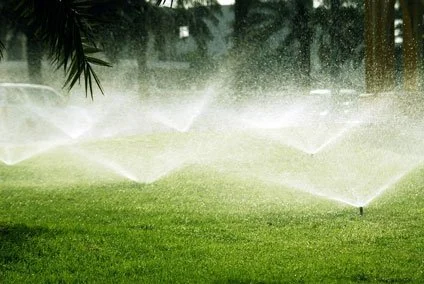
A sprinkler system installation in Livonia, MI is largely settled before a machine arrives on the property. Zone count, head spacing, pipe sizing and the depth everything sits at are worked out on a plan, and the days of work that follow are the execution of those numbers rather than a series of judgment calls made in the yard.
Teddy’s Lawn & Landscape brings more than 20 years of planting and irrigation experience to every system we put in the ground. That experience shows up mostly in the decisions nobody sees, because an irrigation system is almost entirely buried and the parts a homeowner can inspect are the few inches of each head that sit above the turf.
Irrigation is also the one landscape system a homeowner interacts with through a controller rather than by looking at it. Getting the design right is what keeps that interaction down to a seasonal adjustment instead of a standing argument with a dry patch.
What follows is the sequence our team works through on a residential installation in Wayne County, and the local conditions that push each decision one way or another.
Related: Smart Irrigation Practices for Sustainable Landscapes in Milford and Brighton, MI
How Is a Sprinkler System Designed Before Any Trench Is Opened?
Sprinkler system design starts at the water source rather than at the lawn. The available flow rate and the static pressure at the property set a hard ceiling on how much irrigation can run at once, and every other decision on the plan is made underneath that ceiling.
Those two figures get measured rather than assumed. A property on a long service line, or one sharing a main with a street of similar homes, often reads very differently from its neighbor, and a plan drawn against an assumed figure produces a system that underperforms on every zone at once.
The property then gets mapped: the turf areas, the planting beds, the hardscape surfaces, the trees whose root plates the lines have to respect, and the slopes that will move water after it lands. Those features become the boundaries the zones are drawn around.
What Decides How Many Sprinkler Zones a Property Needs?
Flow, plant type and sun exposure decide how many sprinkler zones a property needs. Flow sets the maximum size of a zone, because all the heads on one zone run simultaneously and their combined demand has to sit comfortably inside the available flow with margin left over.
Overloading a zone starves the heads at the end of the run and produces dry arcs the homeowner notices in July.
Plant type sets the boundaries. Turf, shrub beds and shaded areas want different amounts of water on different schedules, and mixing them on one zone means one of them is being watered on the other’s timetable. A perennial bed sharing a zone with open lawn gets a cycle designed for grass.
Sun exposure splits things further. A south-facing strip against a brick wall loses moisture at a different rate than a shaded north side, and keeping those on separate zones is what allows a controller to treat them differently rather than averaging across the property.
How Are Sprinkler Head Types and Spacing Chosen?
Sprinkler heads are spaced so each one throws far enough to reach the next, and head type follows the shape of the area being watered. That overlap sounds wasteful and is the opposite: sprinkler output is heaviest close to the head and lightest at the edge of its arc, so overlapping arcs are what produce an even depth of water across the ground.
Spacing heads to just touch leaves a dry ring between every pair. Those rings show up as a pattern of pale patches in the first dry August, and no amount of extra run time corrects it because the water distribution itself is uneven rather than insufficient.
Rotors throw a long distance and suit open lawn, spray heads cover tight and irregular areas, and rotary nozzles sit between the two with a lower application rate that suits heavier soil.
Mixing types within one zone is avoided, because they apply water at different rates and the zone can only run one duration.
What Does Livonia Clay Change About Sprinkler Installation?
Livonia clay changes both the watering schedule and the hardware, because heavy clay soil takes water slowly.
Applied faster than it can absorb, the excess runs off across the surface toward the lowest point rather than soaking in, which leaves the high ground dry and the low ground saturated from the same cycle.
The usual answer is cycle and soak scheduling: several short run times separated by rest periods instead of one long run. The total water applied stays the same and the soil gets the pause it needs to take it in, which is a controller setting enabled by a design that anticipated it.
Clay also influences the hardware. Lower application rates give the soil more time, and on sloped sections check valves in the heads stop the water sitting in the lateral after a cycle from draining out through the lowest head and pooling at the bottom of the grade.
How Does a Sprinkler System Connect to the Water Supply?
A sprinkler system connects to the house plumbing at a single tap fitted with backflow prevention, which is the system’s most regulated component.
Backflow prevention stops irrigation water being drawn back into the potable supply, and the device type and its installed height are governed by code rather than preference.
Where that connection is made influences the rest of the layout. A tap taken close to the meter keeps full pressure available to the irrigation mainline, while a connection further downstream shares pressure with whatever the household is using at the time.
The controller location gets settled at the same time. It needs power, a sensible route for the valve wiring, and somewhere the homeowner will actually look at it, which in most Livonia homes means a garage wall rather than a basement corner.
Related: Is a Drip Irrigation System Right for Your Milford and Plymouth, MI Backyard?
What Happens on Sprinkler Installation Day?
Installation day starts with utility locates, and pipe, valves, heads and wiring follow in that order. Gas, electric, cable and any existing irrigation are marked before anything opens the ground, and the plan gets adjusted around anything the locate reveals that the drawing did not show.
Pipe then goes in with a vibratory plow for most of the run, which pulls the line through a narrow slit rather than opening a trench. Crossings under driveways and walks are bored or sleeved, and hand digging takes over near tree roots and existing structures where a machine would do damage.
Valves get grouped into boxes at accessible points, heads are set to final grade, and the wiring is run back to the controller position. Irrigation lines sit well above the regional frost line, which in Southeast Michigan is conventionally taken near 42 inches for permanent footings, because the system is drained every autumn rather than buried below freezing depth.
How Is a New Sprinkler System Commissioned and Adjusted?
A new sprinkler system is commissioned by running and watching every zone, then setting arcs, nozzles and run times to the property. Arcs are set so water lands on planting rather than on siding, driveways and the street, and nozzle sizes are changed where a head is reaching too far or falling short.
Run times get set per zone rather than globally. A turf rotor zone, a spray zone in a bed and a shaded zone all receive different durations, and on clay soil those durations are split into cycles with soak periods between them.
The walkthrough matters as much as the settings. A homeowner who knows where the valve boxes sit, how to shut the system down and how to adjust for a wet week gets considerably more out of the system than one handed a controller manual at the end of the day.
What Does Sprinkler Winterization Involve in Southeast Michigan?
Sprinkler winterization in Southeast Michigan means blowing every zone out with compressed air before the first sustained freeze, every year.
Water left in a lateral through a Michigan winter expands when it freezes and splits the pipe or the head body it is sitting in, so this is an annual requirement rather than a one-off.
The blow-out runs zone by zone at a controlled pressure. Too little pressure leaves water behind in the low points, and too much damages the components the process is meant to protect, which is why it is work for equipment sized to the job.
Spring start-up is the matching visit. The system is recharged slowly to avoid a pressure surge through dry pipe, every zone is run and inspected, and heads that shifted over winter are reset before the first real demand of the season arrives.
How Are Planting Beds Watered Differently From Open Lawn?
Planting beds take water at the base of each plant through drip line, while open lawn is watered overhead. Turf needs even coverage across the whole surface, while shrub and perennial beds are better served by water applied where the roots sit.
Drip line and micro-emitters do that work. Water goes into the soil slowly and directly, very little is lost to evaporation or to wind drift across a driveway, and foliage stays dry, which matters on the plants most prone to disease in a humid Michigan August.
The two systems also operate at different pressures and application rates, so a bed on drip and a lawn on rotors are separate zones as a matter of hydraulics rather than preference.
A system that waters a mulched bed with a spray head is applying a lawn cycle to a planting and losing a good share of it to the mulch surface.
What Should Be Documented When a Sprinkler System Is Handed Over?
An as-built drawing and a zone chart should be documented when a sprinkler system is handed over.
The as-built drawing records where the mainline runs, where each valve box sits and which heads belong to which zone, and it is what turns a future repair into a fifteen-minute job rather than an afternoon of probing the lawn.
That drawing earns its keep the first time somebody else digs. A fence post, a tree planting or a patio extension are all routine projects that put a spade through an unmarked lateral, and a recorded route is what keeps those from becoming irrigation repairs.
The zone chart matters alongside it. Knowing that zone four is the shaded north bed rather than a number on a controller is what allows a homeowner to adjust one area after a wet week instead of changing a global setting and affecting the whole property.
What Does a Rain Sensor Add to a Sprinkler System?
A rain sensor interrupts the controller when enough rainfall has landed, so a scheduled cycle does not run across a lawn that received an inch of water overnight. In a climate with Michigan’s summer thunderstorm pattern, that is a component which pays for itself in a single wet August.
Soil moisture sensors take the same idea further by reading conditions at root depth rather than counting what fell. They suit properties with pronounced wet and dry areas, because the reading comes from the ground the system is actually watering.
The value in both lies in what does not happen. Overwatering produces shallow-rooted turf that struggles in the next dry stretch, encourages disease in humid weather, and runs a water bill the homeowner had no say in, so a sensor removes a problem rather than adding a feature.
Map Out Your Sprinkler System Installation in Livonia, MI This Winter
An irrigation system is judged in its third August, not in its first week, and the things that decide that outcome are the flow measurement, the zone boundaries and the head spacing that were settled before anyone opened the ground. A plan drawn over the winter puts your installation at the front of the spring schedule rather than behind it.
Teddy’s Lawn & Landscape has served homeowners across Livonia and Southeast Michigan for over three decades, and our team handles sprinkler installation and maintenance for residential and commercial properties.
Schedule your sprinkler system design consultation with Teddy’s Lawn & Landscape and get your plan drawn before spring.
In Summary
How long does sprinkler system installation take on a typical Livonia property?
Most residential systems are trenched, assembled and running inside two or three days once the plan is approved and the utility locate is complete. Larger properties and lots with mature tree roots or extensive hardscape to pass under take longer, because the route has to work around what is already in the ground rather than cutting straight across it.
Does a lawn recover after sprinkler lines are installed?
A lawn recovers after sprinkler lines are installed faster than most homeowners expect. A vibratory plow slices the turf rather than excavating a wide trench, so the lines close over within a few weeks in the growing season. Work done in autumn knits back the following spring once the turf starts moving again.
Can a sprinkler system be installed in sections over more than one year?
A sprinkler system goes in over more than one year successfully when the whole property is designed at the start. The water supply, the mainline route and the controller get sized for the finished system in the first phase, so a later zone taps into capacity that was planned for rather than borrowed from an existing zone.
When in the year should installation be scheduled in Southeast Michigan?
Spring and early autumn are the best times to schedule sprinkler installation in Southeast Michigan, and autumn has the advantage of a quieter calendar and soil that is still workable. Teddy’s Lawn & Landscape schedules design through the winter so the installation lands at the front of the season rather than behind it.
Related: Yard Drainage Contractors in Livonia, MI: Reading the Water Before Anyone Digs